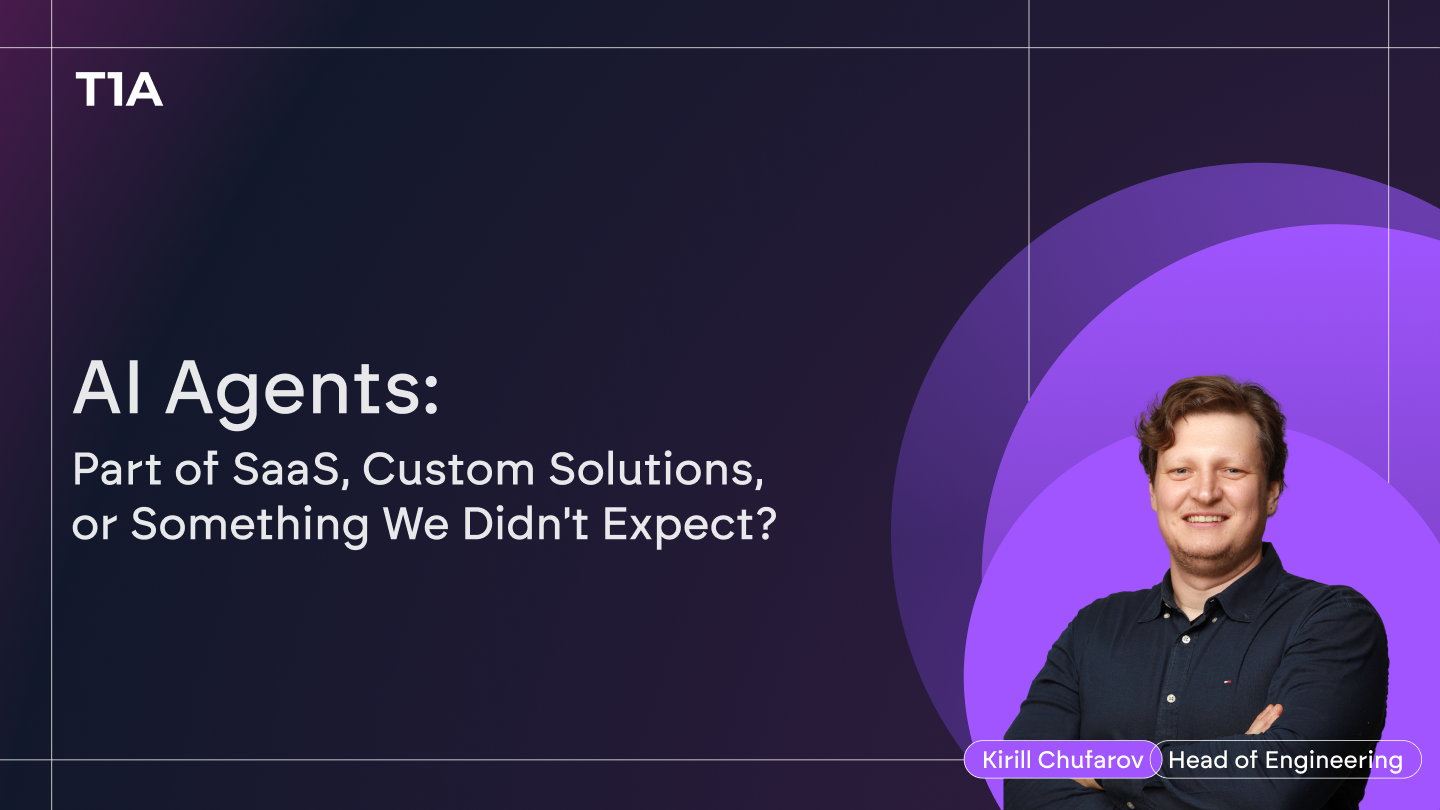
I keep getting the same question in different variations: should we buy agents embedded in our existing tools, or build custom? My answer after working with both - it's both. But there's actually a third option that almost nobody discusses.
Let me explain what I mean.
1. SaaS Products Already Became Agent-Friendly (and It Works)
First thing to understand - major SaaS platforms are not just "adding AI" as a marketing checkbox. They are fundamentally changing how users interact with software. And the best examples I've seen recently come from healthcare.
Recent discussion about healthcare integrations was eye-opening. AI agent sits between patient and doctor during intake - patient describes symptoms, mentions family history, and agent fills EHR forms in real-time. Not just transcription. When a patient says 'my father had the same problem with heart', the agent maps it correctly to the family cardiac history field. The quality of data goes up dramatically because the patient speaks naturally.
This is not some future vision. Microsoft's DAX Copilot is already embedded in the Epic EHR system across 150+ hospitals. Reports show 50% reduction in documentation time. Northwestern Medicine sees 24% less time on drafting notes. Abridge, another ambient AI product, is used by 200+ health systems and won Best in KLAS 2025 award. Physicians using AI in practice jumped from 38% in 2023 to 66% in 2024 - that's 78% growth in one year.
But healthcare is just the most dramatic example. Same pattern repeats across all SaaS categories:
Numbers are hard to argue with: Reddit deflected 46% of support cases, resolution time dropped from 8.9 to 1.4 minutes. HubSpot's Breeze handles 50%+ tickets automatically. Workday cut contract execution by 65%. These are not science projects - production systems with real KPIs.
So yes, agents are definitely part of SaaS now. But that's only half of story.
2. Custom Agents: Where Process Understanding Is Everything
When we move to enterprise-level custom agents, the picture changes significantly. Here we talk about call centers handling hundreds of thousands calls daily, CRM systems with unique business logic, risk assessment in finance, complex data retrieval from multiple sources. These solutions cannot be bought off the shelf because they are deeply specific to how a particular organization works.
DoorDash built a custom voice AI agent using Amazon Bedrock that handles their support calls with latency at 2.5 seconds, reducing escalations by thousands per day. Klarna's custom AI assistant handled 2.3 million conversations in the first month, cutting resolution time from 11 minutes to under 2 minutes - equivalent to 700 full-time employees. Sompo Holdings deployed ML agents to 8,000+ employees for automatic risk evaluation, projecting $10 million in annual improvements. Allianz UK detected 157 million pounds in fraudulent claims using a custom AI system.
These are impressive numbers. But here is what I want to emphasize - the key differentiator between successful and failed custom agent projects is not the technology. It's the depth of understanding existing business processes before you start building anything.
McKinsey found that organizations redesigning workflows - not just adding agents on top - are nearly 3x more likely to achieve meaningful impact. Yet 92% of companies plan to increase AI spending while only 1% report reaching AI maturity. This gap is where projects die.
Why such a high failure rate? Because companies approach agentic AI like traditional automation - map the process, build the bot, deploy and forget. But agents are not bots. They need to understand why certain steps take longer, how teams handle variations, what triggers different process paths. Without this context, you get expensive failures.
Taco Bell deployed voice AI across 500+ drive-throughs. A customer ordered '18,000 cups of water' and crashed the system. The agent couldn't handle accents, background noise, basic edge cases. This is what happens when you skip process understanding and jump to deployment.
The lesson is straightforward: before building a custom agent, you need to map your process completely. Understand where exceptions happen, what causes delays, which steps require human judgment. Define KPIs that matter - not generic AI metrics like accuracy and precision, but process-native metrics: containment rate, time-to-completion versus human baseline, compliance adherence, cost per interaction.
Process mining tools from Celonis, SAP Signavio, and ServiceNow are converging on the same conclusion - you need an operational digital twin before deploying agents. Without it, agents operate blindly. And blind agents are expensive agents.
Custom enterprise agents represent significant investment: typically $20,000 to $60,000 to build, with enterprise platforms requiring $50,000-$200,000 in professional services. Implementation takes 12+ months. This is not a casual decision. You better understand your process before spending this kind of money.
Now here comes the part that I find most interesting and that almost nobody discusses in industry publications. There is a third category of AI agents that emerged almost by accident. Here's what's interesting: Claude Code was built for software development. Turns out it's actually a general-purpose agent platform. And I'm not the only one noticing this. Simon Willison, one of the most respected developers in the community, wrote directly: "Claude Code is, with hindsight, poorly named. It's not purely a coding tool: it's a tool for general computer automation."
Boris Cherny, the creator of Claude Code at Anthropic, confirmed from their own usage data: "Since we launched Claude Code, we saw people using it for all sorts of non-coding work: doing vacation research, building slide decks, cleaning up your email, cancelling subscriptions, recovering wedding photos from a hard drive."
Anthropic acknowledged this so directly that they renamed "Claude Code SDK" to "Claude Agent SDK" - because the framework now powers much more than coding.
Why does this matter for business? Because Claude Code's architecture - gather context, take action, verify work, repeat - is exactly how professional knowledge work operates. And with MCP (Model Context Protocol) enabling connections to any tool or data source, and subagent architecture allowing specialized workers to collaborate, you get incredibly flexible platform for:
RFP Response Automation. Imagine an agent that reads your 200-page RFP document, pulls relevant information from your previous proposals and company knowledge base, drafts structured responses section by section, and checks compliance requirements. Tools like Stack AI and DeepRFP already demonstrate this workflow using Claude as backbone. For consulting companies dealing with dozens of RFPs monthly, this changes the economics of business development completely.
Consulting and Analysis Work. Bridgewater Associates reports 50-70% reduction in time-to-insight on equity, FX, and fixed-income reports using Claude for scenario analysis. The agent drafts Python scripts, runs analysis, and visualizes projections - replicating what junior analysts do, but in a fraction of time. For consulting firms, this means senior consultants can focus on client relationships and strategic thinking while agents handle data-heavy analytical work.
Deep Internet Research with Custom Tooling. Using MCP servers, you can give Claude Code access to specialized search tools, academic databases, industry sources, and internal knowledge bases. Then you structure research as a multi-agent task: one subagent searches web sources, another checks academic papers, third pulls internal data, and the orchestrator synthesizes everything into a coherent report. This is not hypothetical - people already build these workflows with 20 lines of shell script and zero dependencies.
In January 2026, Anthropic formally acknowledged this pattern by launching Cowork - essentially Claude Code without terminal, built into the desktop app. Fortune's headline captured it well: "Anthropic launches Cowork, a file-managing AI agent that could threaten dozens of startups." A team of four people built it in roughly 10 days - using Claude Code itself.
The paradox is clear: tools designed for writing code became general-purpose agents for any structured intellectual work. And with Agent Skills launched in December 2025 - pre-built capabilities for PowerPoint, Excel, Word, PDF generation - the non-coding use cases are becoming first-class citizens.
What This Means Practically
So when someone asks "are agents part of SaaS or custom solutions?" - the answer has three layers:
Layer 1: SaaS-Embedded Agents. Your CRM, ERP, EHR, HR platform will have agents built in. They handle routine work, improve data quality, and reduce time on repetitive tasks. You don't build these - you configure them. Time-to-value is fast, investment is subscription cost. This is where most organizations should start.
Layer 2: Custom Enterprise Agents. For unique business processes with specific KPIs - call centers, risk assessment, complex data pipelines - you build custom. But only after mapping the process thoroughly, defining success metrics, and understanding where human judgment remains critical. Investment is significant, the timeline is months, but ROI can be transformative when done right. Klarna's equivalent of 700 FTEs from a single agent tells the story.
Layer 3: Agent-as-Platform for Knowledge Work. This is an emerging category that doesn't fit neatly into SaaS or custom buckets. Tools like Claude Code (and now Cowork) give individual professionals and small teams the ability to build sophisticated workflows for research, analysis, document generation, and process automation - without enterprise-scale investment. You don't need an engineering team. You need a person who understands the process and can describe it clearly.
The market is moving fast. The AI agent market reached approximately $7-8 billion in 2025, growing at 45-50% CAGR. By 2030, projections reach $50+ billion. Pricing models are shifting from per-seat to per-task and per-outcome - fundamentally changing economics of software.
But numbers aside, the real insight is this: success with agents is not about choosing between SaaS, custom, or platform approach. It's about understanding which layer fits which problem. Routine data quality improvement in your EHR? SaaS agent. Complex claims processing with 50 exception paths? Custom agent with proper process mining. Weekly competitive research report for your consulting practice? Claude Code with right MCP tools.
The organizations that win aren't arguing about categories. They're composing the right mix for each problem and measuring what matters: lower costs, faster cycles, fewer errors, better data. Everything else is noise.